
I shouldn’t name drop. But think: Roger Federer. The Australian Open. Practice partner. Tennis ball. Fractured foot. They were all involved. Just not the way you might imagine. It was a year ago. Roger was warming up. At the Australian Open. He was on the television screen at the time. I stepped out into my back garden…onto a tennis ball and fractured my foot. Quite the inglorious sporting injury.
Emotional Intelligence (or the lack of it!) makes headlines in one way or another every year at the Australian Open where the stakes are high. This year, there were gruelling long matches played outside during Melbourne’s heatwave. We witnessed players consumed by adrenaline…until the torment of injury kicked in at which time they had to put their emotions aside, re-tie their laces, stand up off the bench, wipe the sweat off their brow and continue, displaying almost a robotic-like demeanour.
In the first five minutes of the Women’s final, we saw Serena’s heightened emotions. We’ve heard her say several times that playing her sister is the hardest match of all. One slip of the foot hushed the crowd who felt her intensity as she smashed her racket into the court surface, clearly frustrated. We saw the self-destruction of Nick Kyrgios in his final match against Italian Andreas Seppi as his lack of emotional control inevitably brought him into the spotlight yet again for the worst of reasons.
So, a question for you. If I gave you an option of raising your IQ by 20 points, you’d probably say yes in the blink of an eye. But, what if it was at the expense of another intelligence?
Articles like this have prompted us to assign a numerical figure and consider the value of 3 big traits – IQ, Emotional Intelligence and Grit, and the impact they have on success. If you could genetically design your future offspring and you had ‘250 points’, how would you divide your points between the three? Which intelligence would you prize the most?
Studies have shown that 70% of the time, individuals with an average IQ have outperformed those who have a high IQ (Peter Salovey & John D. Mayer, 1990). So why might those with high intellectual ability fall behind?
The weight given to one’s Emotional Intelligence quotient (EQ) over IQ as a predictor of success in many contexts is increasing as theories of IQ being the sole source and standard of excellence have been debunked. The rules of the employment game are changing. How well do we manage our emotional state at work when tested and what time and energy do we devote to strengthening our social competence with colleagues?
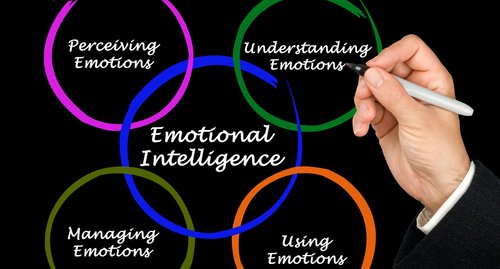
Emotional Intelligence at work is defined as:
“The capacity to effectively perceive, express, understand and manage emotions in a professional manner” (Stough and Palmer, 2002)
In his book, Outliers, Malcolm Gladwell argues that there is a strong relationship between success and IQ but only up to a certain point. Once an individual has an IQ of approximately 120, having an IQ higher than that doesn’t pull much weight as a predictor of success. Therefore, if IQ makes a significant difference only to a specific threshold, it seems logical to conclude that after this threshold, other factors come into play. Factors like EI and grit, tenacity or what I call stick-ability? More than a few people in footy have told me that sometimes those with the most sublime talent as kids or teenagers don’t understand they will have to make sacrifices, work hard even when they don’t feel like it and steel themselves for withering feedback. Some bug out when they realise discipline, hard work and resilience will make the difference between being the talented youngster and having an AFL career. Being able to deal constructively with sometimes brutal (not cruel) feedback is a measure of one’s EI.
Increasingly, companies are looking for Emotional Intelligence in candidates they hire and as a focus of their leadership development. In comparison to IQ, the focus is on personal attributes such as self-awareness, empathy, intuition, adaptability, social skills and emotional control, particularly under extreme pressure.
Tips to improving our Emotional Intelligence – Things to Think About
· How often do we reflect on our emotions? How well do we balance work and life outside work? What do we do to achieve flow and peace? And do we readily give ourselves permission to do so?
· Do we have a supportive network of colleagues at work? What is the true focus of our interactions? Are they quality relationships that nourish? Can we count on each other?
· What investment do we make in our personal and professional development? Are we growing and learning every day? Does fear or complacency thwart that development?
· How good are we at recognising the signs that we’re not doing well? How clear are we on the ‘refresh’ strategies that get us back on track? Do we employ them readily?
· What self-defeating patterns (of thought or action) do we continue to reinforce? Do we understand why they seem to serve us even when they don’t?
· Are we pro-active or reactive in relation to difficulties and challenges that arise at work? How well are we working to respond rather than react in situations? And do we know what’s actually going on in situations we find it really difficult not to react?
· What are the main challenges we face when dealing with difficult key business relationships? Do we have the ability to be assertive and express difficult emotions when necessary? Are we able to ‘bounce-back’ when things don’t go our way?
When our ‘state’ is not what we want it to be, we can do one of two things.
1) Change our thought. Restructure the doom and gloom, awfulising and catastrophising.
2) Shift our physiology, move our bodies, take control of our breathing – either start breathing or belly breathing (Breathe in, tummy out or breathe out, tummy in. Counter intuitive, I know, but ensures good deep diaphragmatic breathing).
We live in an era where the case for Emotional Intelligence has been fought and won. Self-awareness and self-regulation are critical pathways to resilience. What strategies do you use to help your emotions work for you and not against you? As always, would love to hear your thoughts.